Journal · Buyer's guide · 28 September 2026
Authentic Petrykivka painting: how to tell an original from a print or a souvenir before you buy a gift this season
An authentic Petrykivka painting is one painted by hand, straight onto the surface with no drawing underneath, by a painter you can name. You can check it in five places: the stroke, the paint, the finest lines, the signature and the record behind the work. Prints and stencils fail the stroke checks, and a mass souvenir, by the trade's own rule, carries a logo in place of a signature. Two of the checks, the signature and the stems, are the tests Petrykivka masters name themselves, and a buyer in Canada can run all five on a listing, at a fair or with a painting in hand before the holidays.
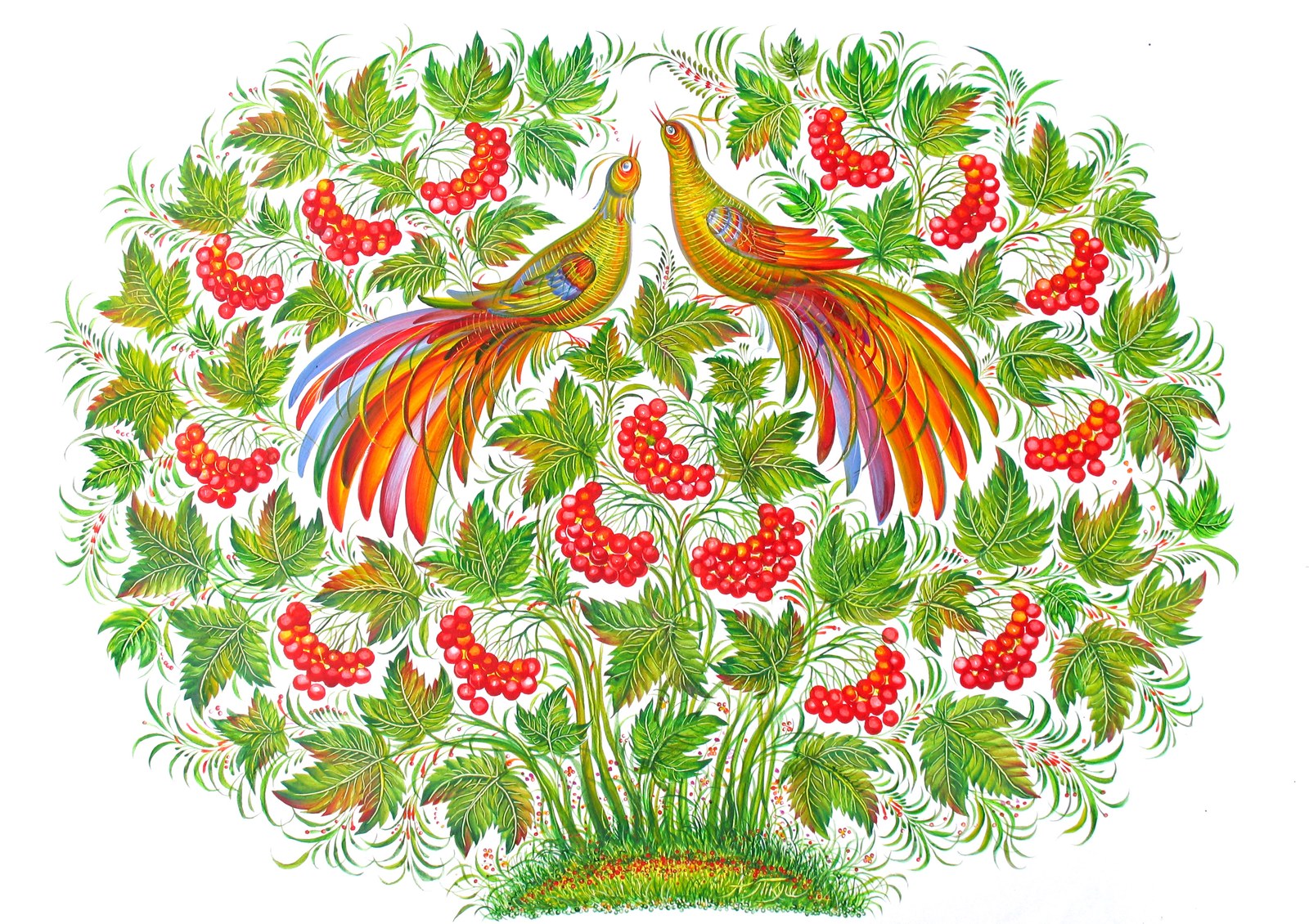
What Petrykivka painting is, and what “authentic” can mean
Petrykivka painting is the ornamental folk painting of the village of Petrykivka in Dnipropetrovsk oblast, Ukraine. UNESCO inscribed it in 2013 on the Representative List of the Intangible Cultural Heritage of Humanity as element 00893, decision 8.COM 8.29 (UNESCO). The tradition took shape in the mid-19th century as painting on the whitewashed walls of village houses and moved onto paper, wood and objects later (Wikipedia UA · Great Ukrainian Encyclopedia).
A UNESCO listing recognises a living practice as a whole; the provenance of a single painting comes from the painter's signature and record. The Convention behind the list focuses on safeguarding and leaves intellectual property to existing law (UNESCO ICH, intellectual property). In Ukraine the name itself is registered as the geographical indication “Petrykivskyi rozpys” (Petrykivka painting), No. 3121, registered on 26 October 2020 for souvenir products, tableware and consumer goods from Petrykivka and its district (register extract). UNESCO's own ethical principles also say that “authenticity and exclusivity should not constitute concerns” in safeguarding (UNESCO, principle 8).
So a buyer gets further by asking about provenance: who painted the work, where, when and on what. That question has an answer for every original, and the five checks below get you to it.
Five signs of an original Petrykivka painting
An original shows the hand in five places, and a close photograph in daylight is enough to check most of them.
- The stroke is laid in one movement, with nothing drawn underneath. The Ukrainian register of the geographical indication states that all Petrykivka masters paint without a pre-drawn contour and without any measuring instrument. Petals, stems and berries are each made in a single stroke, stems do not cross each other, and every flower and berry hangs from a stem (Wikipedia UA). The master Halyna Nazarenko names that last rule as the second test after the signature (Rukotvory, 2015).
- Two colours sit inside one stroke with no seam. The perekhidnyi mazok, the transition stroke, carries one colour in the body of the brush and another on the tip, so a single pull lays a gradient. The register of the geographical indication singles it out as the distinctive stroke of this painting (register extract).
- The paint has body, and the berries carry a fingerprint. Masters paint with egg tempera or gouache, and with oil under lacquer on wood (petrykivka.dp.ua). Berries are set with a fingertip, which leaves a round dot, lighter and raised at the centre, ringed by a darker edge. Under light from the side you see relief; a print is flat.
- The finest lines thin away to nothing. Petushynnia, the fine tracery, is drawn with the koshachka, a brush made from cat fur. The register of the geographical indication records that this tool exists only in Petrykivka painting. Under a loupe a painted hairline shows paint thinning out at its tip; a stencil or vector line keeps its width to the end, and a print shows its dot pattern even in the finest line.
- The work is signed, and its record exists. Nazarenko's first test is the signature. Valentyna Panko, daughter of the master Fedir Panko, put the trade's rule this way: the logo belongs on mass-produced souvenirs, and the signature on authored works (interview, 24.08.2014). A seller of an original can tell you the painter's name, the year and the ground.
hrebinets · the comb
Press first, then drag into a hair. Look for teeth that taper to nothing.
zerniatko · the little grain
Touch lightly, then press. Grains line a stem with their points outward.
horishok · the hazelnut
Two curved combs facing each other, a grain between them.
perekhidnyi mazok · the transition stroke
Two colours in one pull. Look for the gradient with no seam.
Print, stencil or souvenir: how to tell them apart
A print reproduces an original by machine, a stencil repeats a fixed outline, and a souvenir is painted quickly and in quantity. Each one is a legitimate thing to own when it is sold under its own name. The table shows what gives each of them away.
| What to look at | Hand-painted original | Print or giclée | Stencil or transfer | Mass souvenir |
|---|---|---|---|---|
| Edges under a loupe | Brush marks, paint body | Dot or inkjet pattern | Hard, even outline | Brush marks, often fast and thin |
| Colour change inside a petal | One seamless transition stroke | Copied gradient, dot pattern under a loupe | Flat fills side by side | Present, simplified |
| Repeated border | Each flower tilts a little differently | Copies the original exactly | Identical repeats | Near-identical repeats |
| Surface in side light | Relief on berries and thick strokes | Flat | Flat or uniform film | Often under lacquer |
| Signature | Painted or written by the painter | Printed with the image, if any | Usually none | Logo or none |
| Record | Painter, year, ground, paints | Edition size, printer | Rarely any | Maker or workshop |
Two notes help with souvenirs. Black lacquered boards and plates are a 20th-century factory format: the black lacquered ground was first used at a souvenir factory in Kyiv, where Petrykivka painters moved in 1936–1944, and the Druzhba factory in Petrykivka later made it the standard. The historic ground is white: whitewashed walls and white paper (KNUKiM library · Wikipedia UA · Great Ukrainian Encyclopedia). A black-ground piece can still be painted by hand, so treat colour as a clue about the format and rely on the stroke for the rest. An editor's note to a 2015 interview with the master Halyna Nazarenko records that painters employed at the Centre of Folk Art “Petrykivka” paint a set number of souvenirs each month (Rukotvory, 2015), so a painted souvenir from the village is real Petrykivka in a different class from an authored, signed work.
Heritage Crafts in the United Kingdom lists Petrykivka as Endangered and names “mass production and cheap imitations (often digital reproductions or factory prints)” among the pressures on the craft (Heritage Crafts).
Questions to ask a seller before you pay
Six questions settle most listings, and a seller of an original answers them without effort.
- Who painted it, and where did they learn? A name you can look up is the start of provenance.
- When was it painted, on what ground, and with which paints?
- Where is the signature?
- Is it a one-off, or one of a series? For a print: how large is the edition, and how was it printed?
- Can you send a close photograph of one berry and one two-colour petal, in daylight?
- Will a written record come with the invoice?
A vague answer to the first question is the clearest warning sign, whatever the price.
Buying directly from the artist
Buying from the painter shortens the chain of provenance to one link: the person who made the work hands it to you with its record. On this site every commissioned work follows the same handover, set out on the Commission page: the author signs the work, and a record goes into the archive with photographs, the date, the ground, the paints used and the painter's name. You receive a copy of that record with the invoice.
A one-off piece for a collector can be painted on paper, board or canvas. The composition stays with the painter, because the whole technique rests on marks laid without correction; you choose the size, the ground and the framing. Oksana Pikush was born in Petrykivka and learned at home from her parents, Andrii and Maria Pikush, and from the master Ivan Dmytriuk. Her line of teachers, Tetiana Pata → Vasyl Sokolenko → Andrii Pikush, is documented with sources on the Masters page.
The Commission page gives 4 to 8 weeks from the agreed size to a finished painting, with framing quoted separately; the exact date depends on the size and the ground and is fixed in the written quote. For a gift wanted by late December, a brief sent in October leaves room for the painting and the framing.
The gift season: an original, or a place at the table
For a holiday gift there are two good routes: an original with its record, or a place at a class where the person paints their own. Each suits a different person.
- An original suits a collector, a new home or a family with roots in Ukraine. Start in the gallery to see the range of the tradition, then send a brief through the Commission page.
- A class suits someone who likes to make things. Classes run for children and adults, online and in person across the Greater Toronto Area, and a group can book its own date. Details are on the Learn page, where the first stroke, zerniatko, is taught free in a twenty-minute lesson.
- Both together: a small original and a class, so the person understands how the painting on their wall was made.
Questions people ask
Where can I buy authentic Petrykivka art in Canada?
From a painter you can name, with the work signed and a record of the date, ground and paints. Petrikivka.com offers signed originals painted by Oksana Pikush, a painter born in Petrykivka and working in the Greater Toronto Area; a request goes through the Commission page.
How can I tell if a Petrykivka painting is hand-painted?
Look for a colour change inside a single stroke, hairlines that fade out at the tip, fingerprint-edged berries with slight relief, small differences between repeated flowers, and a signature. A loupe shows brush marks on an original and a dot pattern on a print.
Is Petrykivka painting on a black background traditional?
The historic ground is white: a whitewashed wall or white paper. The black lacquered ground was first used at a Kyiv souvenir factory and became the standard at the Druzhba factory in Petrykivka. Contemporary masters also paint on black, blue, green and red grounds.
Does the UNESCO listing certify a Petrykivka painting?
UNESCO inscribed the practice in 2013 (element 00893); the listing covers the tradition as a whole. In Ukraine the name is protected as geographical indication No. 3121; for a single painting, provenance comes from the painter's signature and record.
Is a Petrykivka class a good gift?
Yes, for anyone who enjoys making things. A class covers the named strokes step by step, and every participant leaves with a finished painted sheet. See the formats on the Learn page.